
S.T.A. DATA offers software and services for structural calculation. Practical, truly operational tools, created by a team of expert professionals, to solve every need.

The “Steel Verification FEM” module is the dedicated environment for the structural checking of steel beams and columns, enabling static and seismic checks to be performed using the internal forces from the global FEM analysis directly, ensuring consistency between the model and the results.
The frame verification environment provides an immediate reading of the results thanks to graphic coding and the automatic identification of the most unfavourable combinations. Elements that fail to pass verification are flagged with a yellow triangle next to their name.
In the 3D model, tooltips use distinct colours to highlight the verification status of the elements and indicate the most critical combination. This allows the designer to quickly identify critical issues, compare different solutions, and immediately assess the effects of design changes.
The module integrates into the FEM workflow as a natural extension of the analysis, accompanying the process from the model to the verification within a single, coherent environment. It represents a comprehensive tool for the design and verification of steel structures, improving the safety, reliability, and efficiency of the project.


Once the geometry has been defined in the “Structure” environment, the building is analysed in the FEM solver, where mesh discretization makes it possible to obtain realistic internal forces derived directly from the global model. Steel beams and columns are checked at both the Ultimate Limit States (ULS) and the Serviceability Limit States (SLS), ensuring full control over stress parameters such as axial force, bending moment, and shear.
The integration of a comprehensive library of steel profiles allows the use of standard sections, such as IPE and HE, or custom built-up profiles, providing great flexibility during modelling. A crucial aspect concerns stability checks: the software handles axial, flexural, and flexural-torsional buckling phenomena by applying Method A or Method B, in full compliance with the Italian NTC building code and Eurocode 3.
The interpretation of results is made straightforward through summary tables, safety factors, and diagrams that clearly highlight any design issues. Overall, the FEM module proves to be an essential tool for the analysis of steel frames, providing the designer with a reliable, integrated, and well-informed structural assessment.

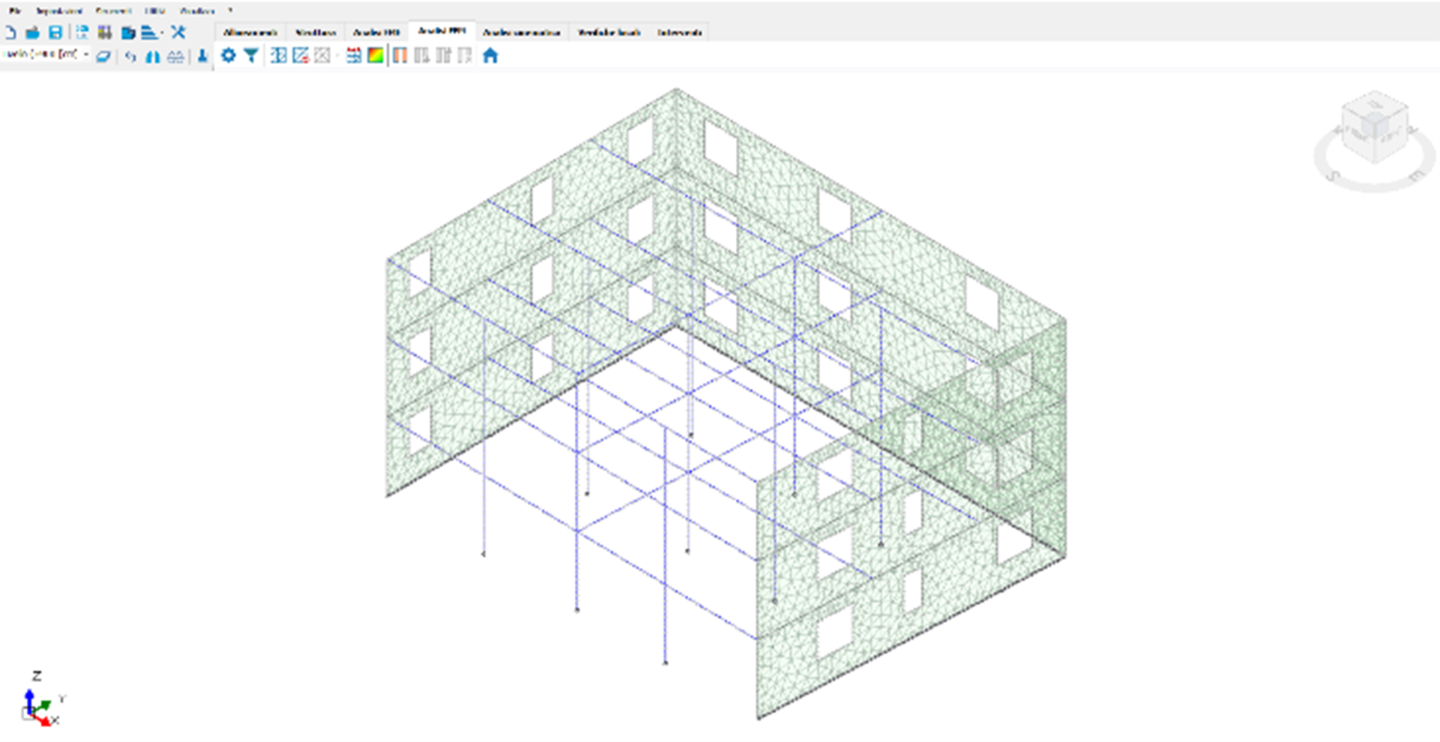
The finite element approach makes it possible to evaluate the overall behaviour of the structure under seismic action, directly accounting for the distribution of stiffness and mass and thereby overcoming the simplifications of traditional methods. Once the model has been defined, mesh discretization ensures an accurate analysis of displacements, internal forces, and interactions between the various components.
Checks on steel beams and columns are carried out using the internal forces derived from the global FEM analysis, with reference to the seismic limit states and the most unfavourable load combinations. As in the static case, the software classifies the sections and, where they fall into Class 4, automatically calculates their effective properties.
For seismic verification, 3Muri Project offers the designer two different code-based approaches compliant with Eurocode 3: the Simplified Method and the Classical Method. Axial, flexural, and flexural-torsional buckling checks are carried out, as with the static checks, using either Method A or Method B, in accordance with the NTC building code and EC3.
Finally, the results are summarized through safety factors and intuitive graphics, facilitating the immediate identification of critical issues.


S.T.A. DATA offers software and services for structural calculation. Practical, truly operational tools, created by a team of expert professionals, to solve every need.
